Wavy hair rarely repeats the same performance every morning. One wash produces defined bends, the next leaves a straighter crown and a strong kink underneath, and humid weather changes the outline again. That variability is exactly why choosing haircuts for wavy hair by a polished reference photo can go wrong. A dependable cut works with the usual range of your wave pattern, keeps enough weight for control, and still creates movement when you do little more than air-dry.
Start with the wave pattern you actually wear
Assess your hair after a normal wash rather than after a salon blowout. Note where the first bend begins: at the root, around the ears or only near the ends. Hair that stays straight through the crown and waves below the cheekbones needs a different layer placement from hair that forms an S-shape close to the scalp. Also look underneath. The nape is often curlier than the top surface, which can make a blunt line lift unevenly once dry.
Use enough layering to release movement, not fullness
Density and strand thickness change the result as much as pattern. Thick, dense waves may stretch under their own weight and expand into a broad lower section. Fine waves can form beautifully but lose visual fullness if the perimeter is over-layered. Gather the final few centimetres into your fingers: if the ends already feel light or transparent, preserve a stronger baseline. If the bundle feels bulky and the crown lies flat, careful internal weight removal may help.
Bring photos of your own hair on a good air-dried day and a difficult one. The contrast shows whether frizz comes mainly from weather, disrupted wave clumps or a shape that pushes too much volume into one area. It also prevents a stylist from planning around the unusually perfect pattern you achieved once with forty minutes of styling. The cut should support the routine you repeat, not the routine you hope to adopt.
Layers help wavy hair bend because shorter sections carry less weight. The useful amount depends on where the wave starts and how much density can be removed without exposing gaps. Long, subtle layers often suit fine or loosely wavy hair: they create separation while leaving a solid edge. Denser hair can tolerate more variation between the crown and perimeter, especially when the lower half currently forms a heavy triangle.
Ask where the shortest layer will land when dry and how it will connect to the longest pieces. A short crown layer can add lift, but if the top section is naturally straighter it may simply sit as a fluffy shelf above wavier lengths. Layers cut around the cheekbones or jaw can encourage face-framing bends, though they will require enough length to tuck behind the ear if that is part of your day. These practical endpoints matter more than the total number of layers.
Weight removal is not the same as visible layering. A stylist may use internal sections to reduce bulk while keeping the surface and perimeter calm. That can help dense waves fall closer to the head, but over-thinning creates short strands that escape from the main clumps and appear as frizz. Fine ends are especially unforgiving. If you want movement without a piecey texture, request soft connection and a substantial bottom line rather than aggressive texturizing.
Compare a lob, a soft shag and a long shape
A lob places the perimeter somewhere between the jaw and collarbone. On wavy hair, it creates a clear silhouette and removes enough weight for bends to appear. Collarbone length offers more room for shrinkage and usually still reaches a low ponytail; a jaw-length version makes a sharper statement but may widen at the sides. Check where the dry ends meet your shoulders, since contact with a collar can turn the bottom wave outward.
A soft shag shifts more attention upward with shorter crown layers and greater separation through the sides. It works well when the aim is an airy, slightly undone outline and the natural wave begins high enough to support it. The tradeoff is consistency: on a low-definition day, those short sections may need diffusing or a little manual shaping. A strong shag also grows out more noticeably than long blended layers because the distance between the top and bottom sections is larger.
Long wavy hairstyles rely on weight for a smoother fall. Face framing and a gentle U-shaped perimeter can make the cut feel intentional without sacrificing the ability to braid or tie it. If waist-length hair looks flat, adding many short layers is not the only answer; moving the perimeter up a few centimetres may make the ends look denser and allow the existing wave to rebound. Compare what matters more to you: maximum length, crown lift, or a strong air-dried outline.
The decision is easiest when you picture a rushed morning. A lob gives a defined shape even with limited styling, but short pieces may not tie back. A soft shag offers the most built-in texture, yet asks for some attention at the crown. A long shape provides flexibility and control, although its movement can be subtle. None is inherently better for waves; the best option matches both the pattern and the amount of daily handling you accept.
Choose bangs for a pattern that changes
Curtain bangs are often paired with wavy haircut ideas because their curved split echoes natural movement. They are also less effortless than they appear. A fringe that bends perfectly on wash day may separate around a cowlick the next morning or shrink higher in damp weather. Begin with enough length to tuck the sides behind the ears if flexibility matters, and decide whether the shortest point should sit near the cheekbone, jaw or brow.
A full wavy fringe needs room for variation. Cutting it to one exact wet line ignores the way individual sections dry. A conservative first pass followed by refinement on dry hair gives a clearer view of the final height. If the front pattern is much straighter than the rest, a short fringe may require daily wetting and reshaping. If it is curlier, allow for more lift than the side sections.
Glasses, exercise and parting habits are practical tests. Curtain pieces that land on a wide frame can kick away from the face; a brow-length fringe may cling during a workout; a strong side part can make a symmetrical section feel lopsided. Ask the stylist to move the front hair into your usual positions before cutting. Longer face framing can deliver much of the same change while remaining easier to pin back or grow out.
Preview the cut as an ordinary wash-day result
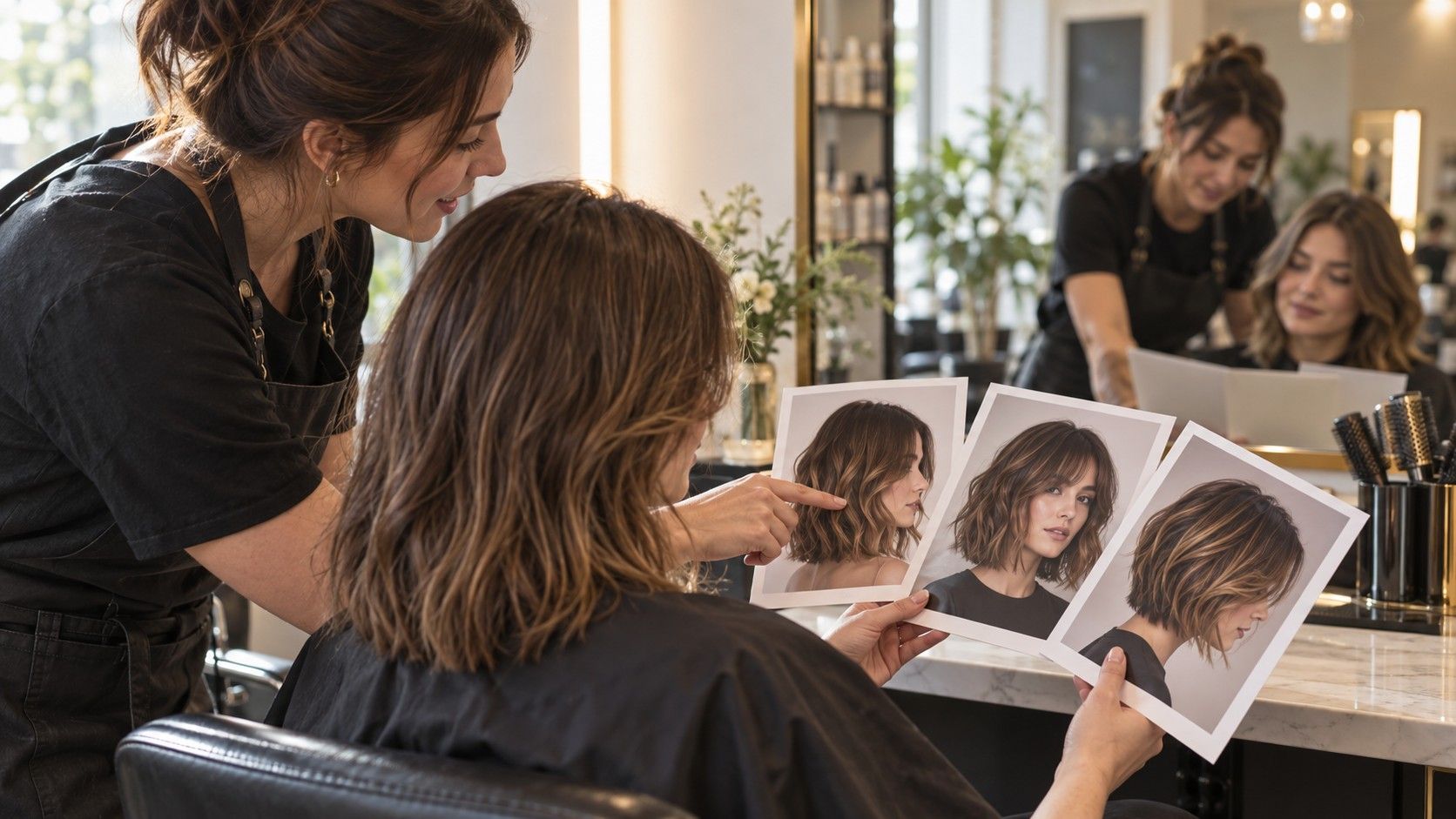
Reference photos become useful when you identify the structural feature rather than copying the entire finish. Point to the height of the first layer, the density of the bottom edge or the width around the cheekbones. Then check whether the model has a similar amount of hair and a similar starting pattern. Large curling-iron bends can resemble natural waves in a still image, but they do not reveal how the cut behaves after air drying.
Explain your routine in concrete steps. Say whether you brush while wet, scrunch, plop, diffuse or leave the hair untouched, and how long you are willing to spend. Brushing can form larger wave clumps; vigorous towel drying can break them apart; diffusing adds root lift that air drying may not. A cut that depends on a lifted crown will feel different if you always let wet hair dry flat against the scalp.
Before the appointment ends, look at the shape from the front, side and back after the hair is fully dry. Check for a heavy corner near the shoulders, a thin patch at the perimeter or a top layer that does not blend into the sides. Do not request more texturizing merely because the salon finish feels bigger than expected. Let the cut go through two or three home wash cycles first, because your usual technique may produce a softer outline.
If an adjustment is needed, describe the behavior rather than asking for “more movement.” Perhaps the crown remains flat, the lower sides expand, one front piece turns away from the face, or the ends feel too sparse. That language directs the correction to a specific zone and protects the areas that already work. A successful wavy haircut does not make every wash identical; it keeps the silhouette balanced as the natural movement shifts.