Advice about hairstyles for heart shaped faces often reduces the decision to a wide forehead and narrow chin. Real faces are less tidy than that description, and hair rarely behaves like the smooth sketches used to explain it. A better choice begins with the proportion you actually see, then accounts for cheekbones, natural parting, density and the amount of styling you will repeat at home. The aim is not to correct a feature. It is to place the haircut's weight where it looks deliberate.
Notice the proportions first
A heart-shaped face usually appears broader through the forehead or upper cheek area and tapers toward the chin. Some people also have a clear widow's peak; others do not. The cheekbones may be the widest point, which can make the face look closer to a diamond shape in certain photographs. Those overlaps are normal. Use the label to identify useful lines, not to force a rigid diagnosis.
Bobs around the chin
Look in a mirror with the hair pulled back loosely, without lifting the brows or tipping the chin. Compare the width at the temples, cheekbones and jaw. Then let the hair fall into its usual parting. A side part may cover one temple and change the whole outline, while a centre part exposes the upper width evenly. Glasses, prominent curls and tucked hair also affect what you see, so include them if they are part of an ordinary day.
Next, decide which feature you enjoy emphasizing. A short crop can put cheekbones and chin into sharp focus. Waves near the lower face can make the shape feel softer and fuller. Long, straight curtains of hair may create a narrow vertical frame. None is automatically better. The useful question is whether the final silhouette matches your taste when the hair is moving, not whether it makes every width appear equal.
A chin-length bob is frequently suggested because its perimeter places visual weight near the narrower lower face. That principle is sound, but the exact line matters. An edge that finishes at the point of the chin can look precise and graphic. A slightly longer bob, grazing below the jaw, has a looser feel and leaves more room for a bend. If the hair flips outward naturally, that movement can add width without extra styling.
| Bob option | Likely effect | Before you choose it |
|---|---|---|
| Blunt chin-length bob | Builds a strong line beside the lower face | Check whether fine hair holds the edge without daily straightening |
| Softly layered bob | Adds movement around the jaw and chin | Keep enough density at the ends to avoid a thin perimeter |
| Wavy bob below the chin | Places bends and fullness through the lower sides | Allow for shrinkage and the direction of the natural wave |
| Angled bob | Draws the front line downward toward the chin | A subtle angle usually grows out more cleanly than a steep stack |
The front pieces should connect with the rest of the cut. A bob with heavy face framing that begins above the cheekbones can become wide at the top and empty at the bottom, the opposite of what many people expect from this length. Softer pieces beginning near the mouth are easier to blend into the perimeter. On curly hair, that starting point must be judged dry because a chin-level curl may rebound toward the cheek.
Maintenance is easy to underestimate. A blunt bob shows uneven growth and may need reshaping every six to eight weeks if you want a polished line. A layered bob tolerates growth better, but it can demand product to keep the ends separated. Try tucking both sides behind the ears during the consultation. If that is your usual habit, it removes the volume the cut was meant to place near the chin and should influence the design.
Bangs with movement
A curtain fringe divides the upper frame and sends the eye along two diagonals. For a heart-shaped face, the outer pieces can connect the forehead to the cheek area without creating a dense block. The most adaptable version opens near the centre and lengthens toward the cheekbones or mouth. It can be worn flatter on casual days and shaped with a round brush when more movement is wanted.
A side-swept fringe works with a side part and is often simpler to grow out. It covers part of the forehead while adding a diagonal across it, then blends into long layers. Keep enough density for it to move as one section. Sparse, wispy strands tend to separate around humidity or skin oils, leaving neither a clear fringe nor a clean open forehead.
Full bangs create a different mood. A straight, heavy fringe reduces the visible forehead and can make the cheekbones feel more prominent. A curved or airy edge is softer, while longer corners connect to the sides. The choice depends on desired style and upkeep. Full bangs usually need frequent trims, and anyone who exercises often or dislikes hair touching the forehead should consider that daily irritation before making the cut.
Long styles with balance
Long hair does not need to be shortened simply because the face narrows toward the chin. What matters is how the length is distributed. Hair that hangs in one straight, close curtain can emphasize the taper. Long layers introduce bends and separation, especially when the first substantial pieces begin between the cheekbone and collarbone. The lower perimeter should still have enough weight to look healthy.
Face framing is most useful when it follows a continuous path. A short piece near the temple, a second near the cheek and longer sections below the jaw can lead the eye downward without leaving obvious gaps. If you tie your hair back most days, make the shortest piece long enough to stay behind the ear or accept that it will fall loose. That small practical detail determines whether the haircut feels convenient or constantly unfinished.
Waves add width wherever they open. On a heart-shaped face, bends around the jaw and shoulders can balance the stronger upper area, while a flat root prevents unnecessary height at the crown. This does not require a perfectly uniform curling pattern. In fact, alternating bends and straighter ends often look less formal. People with naturally wavy hair should ask for layers that encourage their existing pattern rather than a cut designed for a tong.
Avoid overcorrecting a feature
The least useful haircuts for heart face shapes are often the ones built around eliminating every visible proportion. Removing all volume from the temples, adding maximum bulk at the chin and covering the forehead can produce a cut that feels engineered rather than personal. The face does not need to become an oval. One or two intentional adjustments are usually enough to make the hairstyle feel coherent.
Short hair can be especially good at resisting overcorrection. A pixie with texture through the top and a soft side fringe keeps the face open. A crop with tapered sides can emphasize cheekbones and the chin with confidence. The practical issue is growth: the outline around the ears and nape changes fast, and a fringe that looks light at week one may feel heavy by week five. Discuss the trim schedule before choosing a very precise shape.
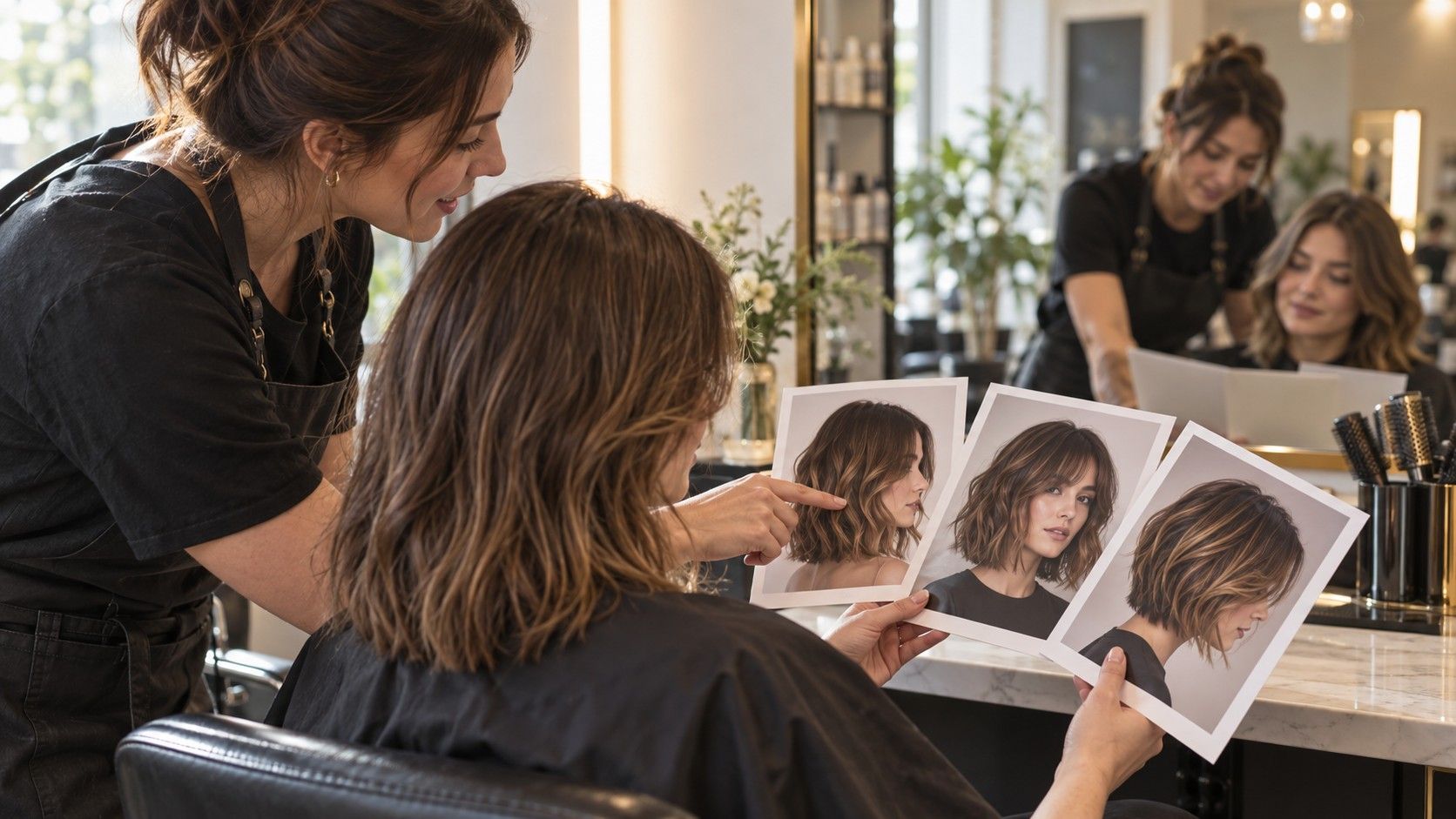
Bring two kinds of reference image to the salon: examples you like and examples you nearly like but would change. Explain whether the objection is length, exposed ears, fringe density, roundness or styling effort. That gives the stylist more useful information than saying you want a heart shaped face haircut. The same label can lead to a blunt bob, long waves or a cropped fringe, and those choices express very different personalities.
The final check is ordinary life. Can the front pieces be secured for work? Does the fringe cope with the hairline? Will the waves appear without a forty-minute blow-dry? A cut that respects the forehead, cheekbones and chin while fitting those answers will look balanced because it is lived in, not because it has hidden the face behind a formula.