Bangs can make an existing haircut feel entirely different, but the decision is less about finding a fringe that is fashionable and more about finding one your hair will actually cooperate with. If you are asking which bangs suit me, look beyond face shape for a moment. Your hairline, natural parting, density, morning routine and tolerance for frequent trims will have just as much influence on whether the result feels easy or irritating.
Decide what you want the fringe to change
Start by naming the job you expect the bangs to do. A long curtain fringe can bring attention toward the eyes and cheekbones while leaving most of the forehead visible. A soft, wispy fringe creates a lighter frame and can break up a broad area of hair without becoming the main feature. A blunt fringe is far more decisive: it draws a clear horizontal line, changes the apparent proportions of the face and gives the haircut a stronger graphic shape.
Compare curtain, wispy and blunt options honestly
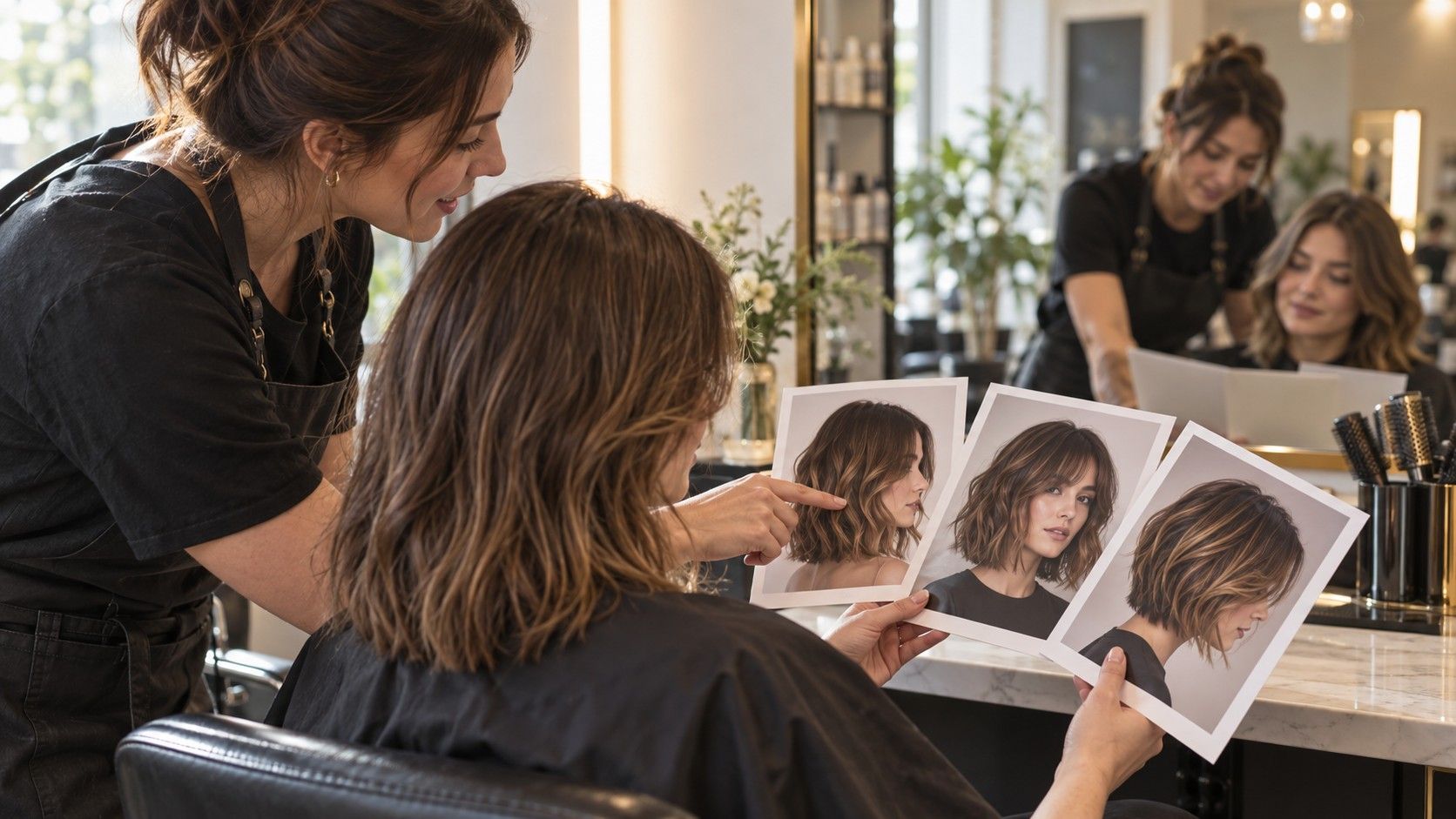
This distinction matters because reference photographs often sell a mood rather than a usable cut. The fringe may look effortless because it has been blow-dried, separated strand by strand and photographed from the most flattering angle. Cover the rest of the hairstyle in the photo and study only the bangs. Notice where they begin, where the shortest pieces sit, how much of the forehead shows and whether the sides connect to cheekbone-length layers. Those details tell you more than the model's face shape.
There is also a practical difference between wanting a small change and wanting bangs to dominate the haircut. If you are uncertain, longer pieces that can be parted or tucked away leave room to adjust. A short, dense blunt fringe does not. Neither choice is inherently better, but they create very different mornings and very different grow-out periods.
The useful question is not simply how to choose bangs, but how much structure you want around the face. The three common families below behave differently even when a stylist adapts their exact length and density.
| Option | What it does | Daily reality | Safer starting point |
|---|---|---|---|
| Curtain bangs | Open through the centre and blend into side layers | Need direction at the roots but can often be tucked back | Keep the shortest point around the brows or upper cheekbone |
| Wispy bangs | Add a light veil across the forehead | Can separate on oily or humid days and may need a quick refresh | Remove less density first; more can be added later |
| Blunt fringe | Create a strong line and make the eyes more prominent | Shows uneven growth quickly and usually needs regular trims | Cut slightly longer than the final idea and refine when dry |
Curtain bangs are often described as low commitment, yet that is only partly true. They are forgiving once long enough to merge with the front layers, but the centre opening must agree with your parting. If your roots naturally fall straight forward, they may need heat and a round brush to split cleanly. If your hair divides strongly to one side, a perfectly balanced centre curtain can keep drifting off course.
Wispy bangs suit people who want movement rather than a solid block, although fine does not mean maintenance-free. Sparse pieces can become stringy after skincare, exercise or a warm commute. Blunt fringe gives the clearest before-and-after effect, but its crisp edge exposes every extra few millimetres of growth. Choose it because you like the line, not because it looked delicate in one softly lit photograph.
Use your brows, eyes and cheekbones as measuring points
Advice about bangs for my face is usually reduced to labels such as round, oval or heart-shaped. Those labels can be a starting point, but fixed landmarks are more useful. Stand in front of a mirror with your hair tied back and hold a section of the front hair at several lengths. A line just above the brows opens the eye area but grows into the eyes quickly. A line touching the brows feels softer, while cheekbone-length pieces create a frame without closing the forehead.
Check the result from the side as well as straight on. Bangs have depth: the section taken from the top of the head determines how heavy they look and how they sit over the forehead. A deep triangular section supplies enough hair for a dense fringe, but it can take volume away from the sides, especially on fine hair. A shallow section stays light, though it may not form the substantial curtain shown in a thick-haired reference image.
Your glasses, brows and habitual expressions deserve attention too. Frames with a heavy top edge can compete with eyebrow-length bangs, and a fringe that looks perfect while still may jump when you raise your brows. Try the proposed line while smiling, talking and turning your head. The goal is not to prove that one face shape is allowed a particular style; it is to see whether the new line supports the features you enjoy rather than constantly colliding with them.
Let the hairline and cowlick set the limits
A cowlick is not a minor inconvenience that disappears once the right fringe is chosen. It changes the direction and apparent length of the hair at the root. Dampen the front section, comb it forward without heat and watch where it separates as it dries. If one side lifts or twists, show that behaviour to the stylist before any cutting begins. Freshly washed, professionally smoothed hair can hide exactly the information needed to plan the cut.
A strong centre widow's peak, uneven temple density or a low hairline does not rule out bangs, but each affects the section. Sometimes the best solution is to work with the natural split and create an off-centre curtain. In other cases, adding slightly more weight keeps a stubborn piece from springing away. Cutting the problem area shorter is rarely the obvious fix; short hair has less weight, so the lift can become more visible.
Texture changes the measurement as well. Wavy and curly hair can contract considerably between wet and dry states, while very straight hair shows the cutting line with little forgiveness. Ask for the final shape to be checked dry and in its natural fall. If you regularly air-dry, say so. A fringe designed only for a polished blowout may look unrelated to the rest of your hair on an ordinary Tuesday.
Match density and length to your actual routine
Density decides whether the fringe reads as transparent, soft or solid. With fine hair, taking too large a section can leave the front looking full while the sides become noticeably thin. With very dense hair, a heavy fringe may form a thick shelf unless internal weight is removed carefully. The aim is not to copy the number of strands in a photograph but to distribute your own hair so the fringe and the remaining cut still look connected.
Before the appointment, rehearse the maintenance for a week. Bring the proposed front section forward after washing, dry the roots in the direction you would need and note the time. If two minutes with a dryer feels reasonable, a fringe may fit easily. If you avoid heat, leave home with damp hair or wear a helmet most days, choose a length that can move, part or pin back without looking accidental.
Climate and skin also influence the result. Humidity encourages waves and cowlicks to reappear; dry air can make wispy pieces static; forehead skincare can make a light fringe separate by midday. These are not reasons to abandon the idea. They are reasons to keep a small comb nearby, wash only the fringe when needed and avoid choosing a cut whose success depends on conditions you rarely have.
Plan the upkeep and the way out before the first cut
Ask how often the chosen edge needs trimming. A blunt fringe may lose its intended position within three or four weeks, depending on growth and starting length. Curtain bangs usually tolerate a longer interval because they can slide outward toward the cheekbones. Wispy bangs sit between the two: the line is less strict, but a few overlong strands can fall directly into the eyes.
Be precise at the consultation. Instead of saying that you want bangs, point to the desired shortest piece, the side length and the amount of forehead you want visible. Explain whether you need to tuck them behind your ears, wear them under a hat or pull all your hair back for work. A stylist can adjust the shape only when those constraints are spoken aloud. It is reasonable to begin longer and lighter, then remove more after seeing the dry result.
Finally, picture month three, not only day one. Curtain pieces usually merge into face-framing layers with the least awkwardness. A blunt fringe grows through an eye-level stage that needs side-sweeping or clips. A wispy fringe can be blended gradually, provided the original section was not too deep. The most convincing answer to which bangs suit me is therefore a combination: a shape you like now, a routine you will repeat, and a grow-out path you can live with when you want your forehead back.